Too Busy to Workout?

Too Busy to Workout?

Sometimes life gets in the way and exercise gets put off. Juggling work, family, house chores and everything in between can get tiring and exercise get put at the bottom of the list. For those times you do find a moment, all you want to do is relax and switch off.

We do not exercise is important. Exercise is important for maintaining a healthy weight range, for muscle growth, improving our fitness and our bodily functioning. So how do we fit exercise into today’s busy lifestyle. Here is some simple ways to be more active  in your every day life.

Walk to Work:
Walking can freshen your mind, give you fresh air and adds to your total step count for the day. Walking to work can decrease your stress as you have some time to think and gather your thoughts on the way to work.

Live to far from work? Can you park further away from work allowing an extra 10 minutes so that you can walk some of the way?

Don’t work? Can you walk to the supermarket or with the kids to school?

Instead of doing blocks around a carpark searching for parks can you take that park a little further away and add to your exercise for the day?

Active Lunch Break:

We all know that feeling when lunch time comes around and you finally sit and relax. As the dreaded minutes tick round and you have to return to work- there is no way you want to get up. Can you instead turn your lunch break into being active?

Getting out of the workplace will allow you to detach from work and clear your mind for the break. Really allowing yourself to relax. Go for a walk around the block rather then spending the whole break sitting. You will feel better for it on returning back to work. A clear mind and more activity in your day.

Standing Desk:

Is your job predominantly a job sitting at a desk for long period of time? Research has shown that sitting- especially crunch over a desk for long periods of time is bad for your health. Sitting for prolonged periods is bad for your posture and can weaken your bones.

Can your desk be converted to a standing desk? Standing at your desk is better for your posture and bones. Standing compared to sitting also burns more calories. Standing more for even part of the day can also help.

Choose the Harder Option:

As we get tired in the day we tend to choose the easier option. When looking at the stairs compared to the lift- if we are tired the lift seems so much more appealing. Making a conscious effort to not take short cuts, even when tired can lead to more activity in the day. Often at work when we take short cuts for being lazy it is often not the best practice and could impact on our work performance. Not choosing the lazy option could improve your work performance.

For example, if you require safety equipment- opting to walk the distance to collect all the safety equipment includes more activity, better job performance and increased safety.

Volunteering to be the one to go and collect items will add more activity into your day and increase your work performance.  If the printer runs out of paper. Volunteering to get more paper will have you seen, and a helpful employee and you are getting more activity. It is all about perspective.

1 hour is 4% of the day:

At the end of the day, 1 hour is only 4% of your day. Allocating an hour to exercise although sometimes can be difficult is about prioritizing. Exercising regularly will increase your fitness, aid your weight loss goals and lead to an overall healthy lifestyle.

The best way to be more active in your day is to allocate sometime to exercise. Caring for your self is important. Exercise releases endorphins which helps your mental health. Turn exercise into a social event by joining a sport or group exercise and it benefits all three elements of health. Being active is important for your well being. The easiest way to ensure you meeting your activity requirements is by prioritizing and scheduling in some time each day- whatever that is.


Winter Workouts

Winter Workouts

Its cold, windy and wet. The last thing you want to do is leave your nice warm bed to workout. Wearing swimsuits is months away. You can easily hide a few extra kilos underneath big jumpers. Everyone looks like the Michelin man in this season with puffy jackets on.

So, excuses are made and the workout is missed. Skipping on your fitness goals, skipping on your health goals and skipping on your weight loss goals.

Instead, follow these simple examples of ways to workout in winter. Ways to keep motivated and reach your fitness goals when it is cold out.

Click Here to find out why Fitness is so important!

Workout Indoors:

You do not need heaps of space to workout. A small amount of floor space will do. Your bedroom or living room floor will be enough. Protected from the wind and the rain, no need to travel anywhere, working out indoors is perfect!

See our post on Indoor workouts for more suggestions on exercises you can do.

Not letting any excuse stop you is the key to kicking your goals! Smash out a killer workout using body weight and your floor without a need to travel anywhere.

Go Swimming:

Getting wet is usually the last thing you think of in winter but can be the warmest place to work out. As soon as you walk into a leisure center the heat (and chlorine smell) hit you. Swimming in a heated pool is a great way to get that cardio without having to brave against the weather.

If a regular heated pool is still too cool- find a hydro pool. Hydro pools are warmer than regular lap pools. Often, they will have scheduled classes such as water aerobics where you can really bust out some energy. Or start in the hydro pool and you might even find you need the cooler pool to push harder once you have warmed up.

Most pool centers now provide services like hair dryers in the changing rooms. Therefore, you can get completely dry and warm post your workout before travelling out into the wind.

Infrared Classes:

Some gyms now offer heated classes. The gym room is heated using infrared heaters to around 40 degrees Celsius (depending on the gym and class). This helps to burn more calories as your body sweats more to keep itself cool. In summer infrared classes can be a real scorcher. In winter they are a great way to forget about the cold outside and breakout a sweat. Check your local area for any classes nearby.

Snow Sports:

Depending on your area and affordability, learning a new skill such as snowboarding, ice-skating or skiing can be a great way to get fit in winter. Not everyone has access to the snow, or it can be too expensive for others. But if your location permits it, training in the snow can be a great way to stay fit in winter.

The seasonal aspect of snow sports adds to the novelty and fun of the workout. Trying something new can challenge new muscles and be a lot of fun. Going out with a sled or toboggan like a child again can be a whole lot of work and fun.

Being Cold Burns More Energy:

We are not recommending you go and develop hypothermia to use energy and lose weight. Being cold dose use up more body energy though. The body has to work harder to stay warm and uses energy in doing that.

The body’s response to cold is to shiver to generate heat. That is why when we are cold you start to shiver. Shivering uses up body energy. Even when the body gets cold but not cold enough to shiver, body energy is still used up. Therefore, being a little bit cold (before shivering), can result in increased energy consumption.  Staying cold for longer periods of time and shivering can be dangerous and lead to hypothermia.

Therefore, braving the wind and the cold and exercising throughout winter can be two fold beneficial. Your body will burn more energy from the workout as it tries to warm your body up at the same time. Knowing that leaving your warm cozy bed and braving the cold will increase your workout efforts should aid to motivate your workouts.

Swimsuit Ready:

As the sun pops its head around the corner and summer can be seen far off in the distant, people want to get swimsuit ready. Fad diets and workout schemes start to pop up. The key to be swimsuit ready is consistent lifestyle actions. Following healthy eating plans and regular workouts. If you continue your exercise through winter braving the cold- you will be swimsuit ready all year round. Get the Swimsuit body starts now and continues all year round with a healthy lifestyle not seasonal fads.

Indoor Workouts

Indoor Workouts
  • Can’t get to the gym.
  • Don’t have weights.
  • Can’t leave the house.
  • Too cold outside.
  • Not enough light outside.
  • Not enough money.

Time to kick every excuse in the butt! Here is a list of indoor workouts that only require, yourself and a small amount of floor. Never an excuse not to workout again- because you can right now standing wherever you are.

Increase or decrease repetitions and sets depending on your own fitness levels. Remember it is the extra 10% you push yourself that makes ALL the difference. The workout should be getting your heart rate and breathing rate to increase.

Unsure of a move- check out our Workout Exercises page first! Explanations and variations for different exercises.

Indoor Workout 1:

Round 1:

  • 10 Burpees– use any modification as required.
  • 10 Pushups– On knees or toes
  • 10 Jumping Squats– Normal squats if unable to jump
  • 10 Sit ups

1 minute break in-between sets. Repeat sets- decreasing by 1 each set.

  • ie. Next set do 9 Burpees, 9 push-ups, 9 squats and 9 sit ups.

Keep repeating with a minute break in-between sets all the way to 0 or until you cannot do anymore. Make a note of where you got to and next time try and push your self to get to one less or even further.

Ideas:

  • Set a timer: See how far down you can get in the time. Next time try to get further in the same time.
  • Swap in and out different exercises.
  • Try and decrease the break in-between. Can you do 2 or 3 sets in a row without any breaks?
  • If you can not do 10 of an exercise yet, start at a lower number and try and work your way up. Can you work yourself up to go above 10?

Indoor Workout 2:

Ab Workout:

Find your favorite workout song with lyrics.

  • Verse 1: Sit ups
  • Chorus: Hold plank
  • Verse 2: Toe taps
  • Chorus: Hold Plank
  • Bridge: V-Snaps
  • Chorus: Hold plank
  • Verse 3 (if third verse): crunches.

Make sure you hold each move until the next section or finish of the song.

Ideas:

  • Change songs- Will provide different time holding different moves.
  • Change moves- For a real effective workout try to combine moves that target similar area. See leg example
  • Verse: Normal Squats
  • Chorus: Squat Sit
  • Verse 2: Sumo squats
  • Chorus: Squat Sit
  • Bridge: Lunges
  • Chorus: Squat sit
  • Verse 3 (if present): jumping lunges

Indoor Workout 3:

Round 1: (3 sets)

  • 10 X Burpees
  • 10 X Push ups
  • 10 X Crawl outs

Plank in between sets for as long as you can.

Round 2: (3 Sets)

  • 10 X Jumping Squats
  • 10 X lunges each leg
  • 10 X Sumo Squats

Wall sit for 1 minute in between each set (or as long as you can to the point where it hurts)

Round 3 (3 sets):

  • 10 X V-snaps (sit ups if you cannot v-snap)
  • 10 X pelvic thrusts
  • 10 X Leg extensions behind

Between Sets- hold Pelvic hip thrust in upward position for 1 min (or as long as you can to the point that it starts hurting).

To find out how to perform any exercises see out page explaining how to and variations of actions- CLICK HERE

To find out why working out is important and more about fitness CLICK HERE

Workout Exercises:

Workout Exercises:
  • How to workout?
  • What Exercises to do?
  • How to perform different exercises in workouts?

Starting to exercise can be over whelming to begin with. It can be difficult to know what to do and where to start.

Conversely, doing the same old boring workout routine can be boring and plateau your fitness progress.

It can be hard without a PT or someone else to know what exercises to do. So, here is a list of different exercises to help you put together your own work out.

See our other post on indoor workouts for ideas of how to combine exercises.

Or See our Fitness page for tips on ways to work with others and to push your self that extra 10% to boost your fitness goals!

Before performing these exercises access your own health, fitness levels, injuries and abilities first. If unsure- seek help from a professional on how to perform these moves safely.

Push-ups:

Focus on the chest muscles. Hands at shoulder width apart under shoulders. Either on your toes or on knees extended underneath you.

Bend at the elbows lowering to the ground so that your nose almost touches the ground. Push up through the arms back into the starting position.

Variations of Push-ups:

  • Push ups on knees to make move easier
  • Elevate your hands with steps, handles to make the push up deeper and harder
  • Triceps push-ups- bring hands closer together- so fingers are close to touching. Pointer fingers and thumb should make a diamond shape underneath chest.
  • Clap push-ups: As you push upwards from the push up- attempt to push off the ground and clap underneath your chest before getting hands back shoulder width apart

Squats:

Stand with your feet shoulder width apart. Bend at the knees placing weight into your heels rather then your toes. Your toes should be able to lift off the ground and not holding the bulk of your weight. Your bottom should be stuck out behind you. Practice by pretending to sit in a chair. Using a mirror to assess your technique can be beneficial.

The lower your squat the more effective for your muscles. Try to squat to seating level or as low as you can go each squat.

Variations of Squats:

  • Sumo Squats: Have your feet wider apart then shoulder width- targets your glutes more.
  • Feet Together: Perform the squat the same focusing on the weight being in your heels and sticking out your bottom- but have your feet together.
  • Jumping Squats: As you push up from the squats add in a jump. Land the jump in squat position and squat again. The power from the jump will add to the intensity of the squat.

Wall Sit:

Place your back up against a wall with your legs shoulder width apart. Lower into a seating position against the wall and hold position as long as you can.

Variations of Wall Sit:

  • Increase the intensity: Add weight to your lap to make the squat harder

Lunges:

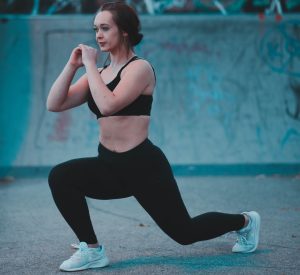
Place one leg in front of your body. Bend so that your front knee bends. Careful that the front knee to not go over your toes. Drop until your back knee almost touches the ground and then rise pushing through both legs.

Variations:

  • Add a jump in-between switching legs
  • Walk and lunge at the same time rather than staying stationary
  • Hold lunge position for extended time
  • Hold lunge position and make small pulsing movements

Sit Ups:

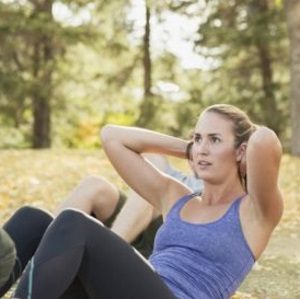
Lie on the ground with your knees bent. Place your hands across your chest on opposite shoulders. Squeeze through your stomach muscles to bring yourself closer to your knees. Once you reach your bent knees, slowly lower yourself back to lying on ground. Repeat.

Variations of Sit Ups:

  • Crunches: Do not lift fully up. Lift head and back off ground until you feel the strain in your abdomen then lower self down. Crunches should be able to be performed quicker then sit ups and target higher up abdomen muscles.
  • Hands Stretched Forward: Having your arms stretched out in front of you will help you pull yourself up. This will make the sit up easier. Once you can do sit ups like this try placing your hands across your chest.
  • Toes Weighted Down: Have someone sit on your toes or tuck your toes under something like the foot of a couch. This will help you to pull yourself up. Try using this method until you can do sit ups without the added help.
  • Use a Weight. Hold a weight outstretched above your head to make it harder. Try to not use the weight to propel you as this will reduce the difficulty.

V-Snaps:

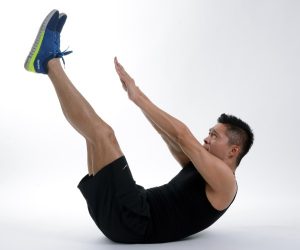
Lie on your back. Keeping your legs straight raise your legs up into the air. At the same time lift your head, shoulders and back off the ground with outstretch hands to reach and try and touch your toes. As you reach your toes, your body should make a V shape. Lower your back and legs slowly back to the ground and repeat.

Variations of V-Snaps:

  • Leave your legs in the air and do not lower and raise your legs. Only lift your back and body up to reach your toes. This will make the V-snap easier.
  • Do not raise your back. Leave your head on the ground and just raise and lower your legs.
  • Practice these two moves isolated until you can combine them.

Toe Touches:

Sit in the ‘sit-up’ position with your knees bent up. Lower your back so that you can feel your stomach muscles working (your core engaged). Keep your back off the ground but not sitting up right. Reach your right hand to touch your right toes, then reach your left hand to touch your left toes. Repeat back and forth.

Variations of Toe Touches:

  • Put your fit further away to extend your reach
  • Hold your feet of the ground

Russian Twists:

Hold similar position to toe touches. Sit in the ‘sit-up’ position with your knees bent up. Lower your back so that you can feel your stomach muscles working (your core engaged). Keep your back off the ground but not sitting up right. Touch your left elbow to the ground on your left side, then touch your right elbow to the ground on your right side. Repeat back and forth.

Variations of Russian Twists:

  • Lift your toes off the ground keeping your legs raised
  • Hot a weight that you shift from side to side

Pelvic thrusts:

Lie with your back on the floor and your knees bent up. Pushing through the back of your legs and bottom muscles raise your bottom of the ground and push up to the ceiling. Then lower you bottom back to the ground. Pelvic thrust is meant to be working the hamstrings and gluets. If this hurts your lower back stop and have someone assess your technique.

Variations of Pelvic Thrusts:

  • Hold the thrust in the air longer
  • Hold one leg up and lift with the other leg.

Crawl Outs:

Stand up straight. Bend forward at the hips to reach the floor. If your flexibility does not allow this bend at the knees in a squat style until your hands reach the floor. Crawl your hands outright until you are in a plank position. Then either crawl your hands back to your feet and raising up back into a standing position- for a stationary crawl out. Or walk your feet to your hands to where your flexibility allows and then standing up.

Plank:

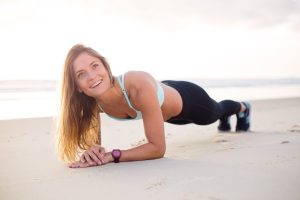
Have you arms shoulder width apart and your legs out stretched behind you. Raise up body onto your elbows and forearms underneath your chest. Rise up onto your toes. Make sure your body is flat and your bottom is not raised into the air.

Variations of Plank:

  • Raise up with your arms outstretched underneath you like a push up rather then on your elbows.
  • Stay on your knees outstretched underneath you rather then raising to your toes
  • Have your feet apart by shoulder width instead of together ensuring to keep your bottom level with your body.